Global Fraud Index: The Essential Resource for Navigating the Modern Scam Landscape
In the digital age, fraud is not merely a series of isolated incidents; it is a dynamic, evolving ecosystem. As technology advances, so do the methods of bad actors, often leaving individuals, businesses, and regulatory bodies one step behind. Historically, understanding the “state of fraud” meant waiting for annual reports, police statistics, or sensationalized news headlines—all of which suffer from significant lag time.
By the time a specific scam type makes the front page of a major newspaper, the peak of its activity has often already passed. To address this information gap, Civoryx was established as the Global Fraud Index. It serves as a real-time pulse of the internet’s collective concern regarding illicit activities, providing a transparent, data-driven look at how fraud attention shifts across the globe.
The Origin and Mission: Why Civoryx Exists
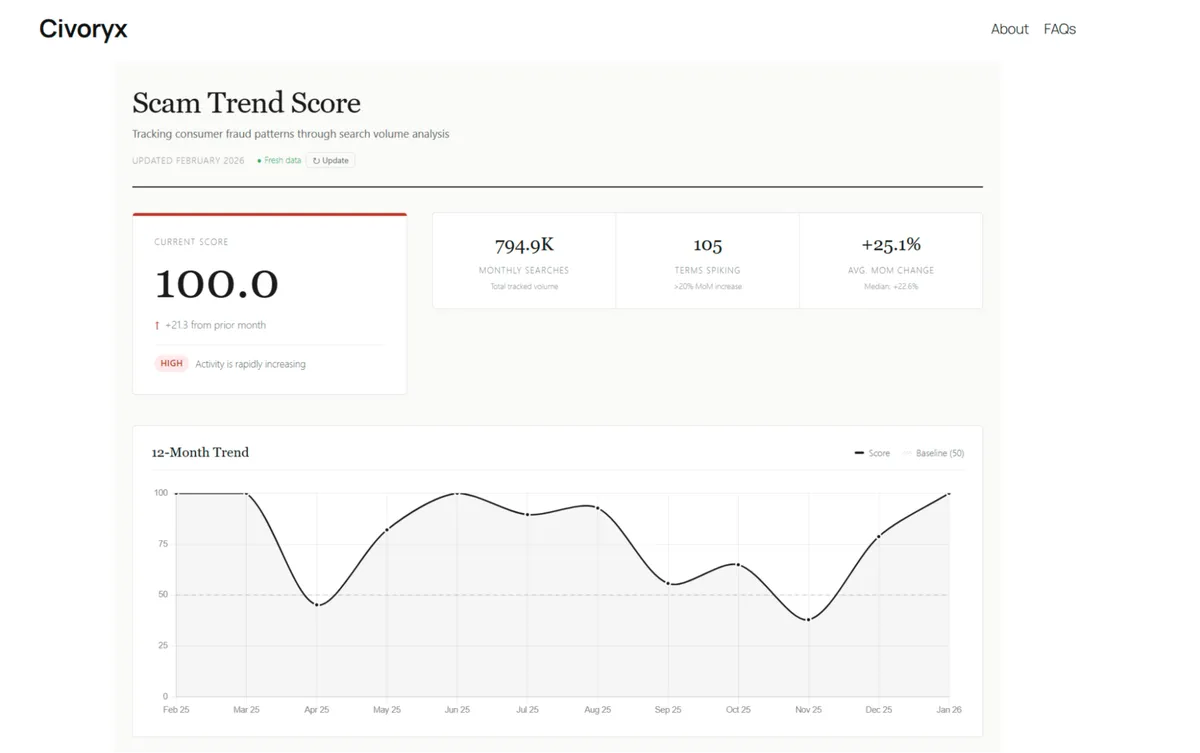
The internet is a vast repository of human intent. When people encounter something suspicious—a strange email, an unusual crypto platform, or a sudden request for money from a “friend”—they turn to search engines. These digital footprints represent an early warning system. Civoryx has been tracking global fraud search behavior since 2019, creating a historical baseline that allows for the identification of anomalies and emerging trends.
The core philosophy of Civoryx is simple: No opinions. No speculation. Just data.
In an industry often clouded by marketing hype or “fear-mongering” from security vendors, Civoryx stands apart by offering a purely objective signal. It exists because fraud evolves faster than traditional reporting can follow. By surfacing these shifts early, the index gives researchers, journalists, and security professionals the “lead time” necessary to issue warnings and implement defenses before a scam reaches its maximum destructive potential.
How the Global Fraud Index Works: Three Layers, One Score
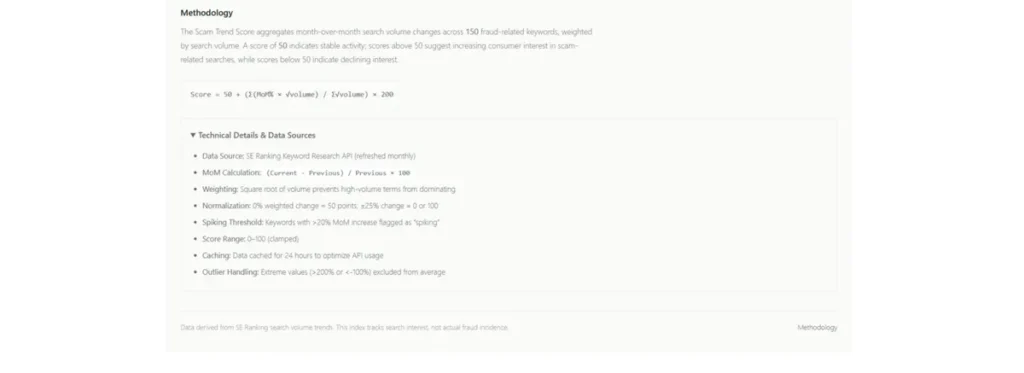
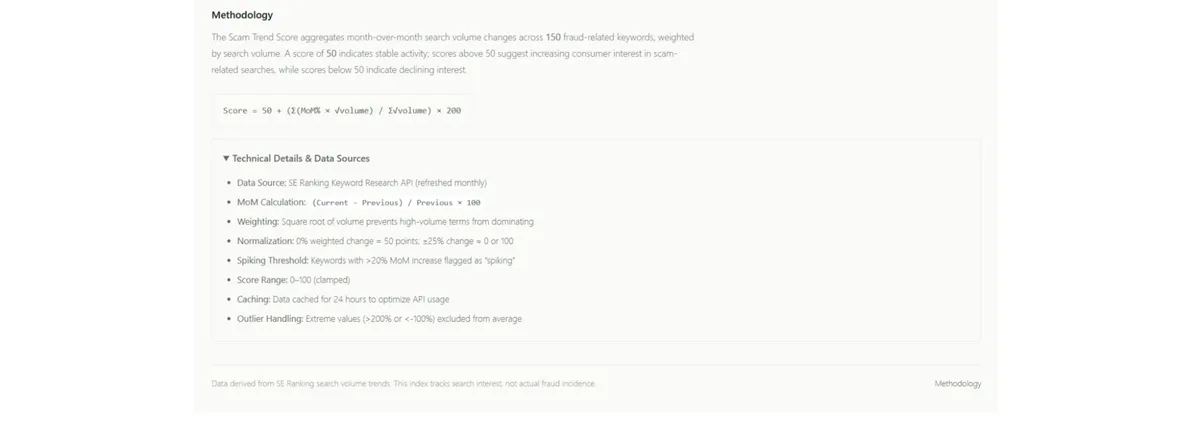
Civoryx operates through a rigorous, three-layered methodology designed to distill massive amounts of search data into a single, actionable metric: the Scam Trend Score. This score is not an arbitrary number; it is a composite signal derived from real-world behavior.
1. Monitor
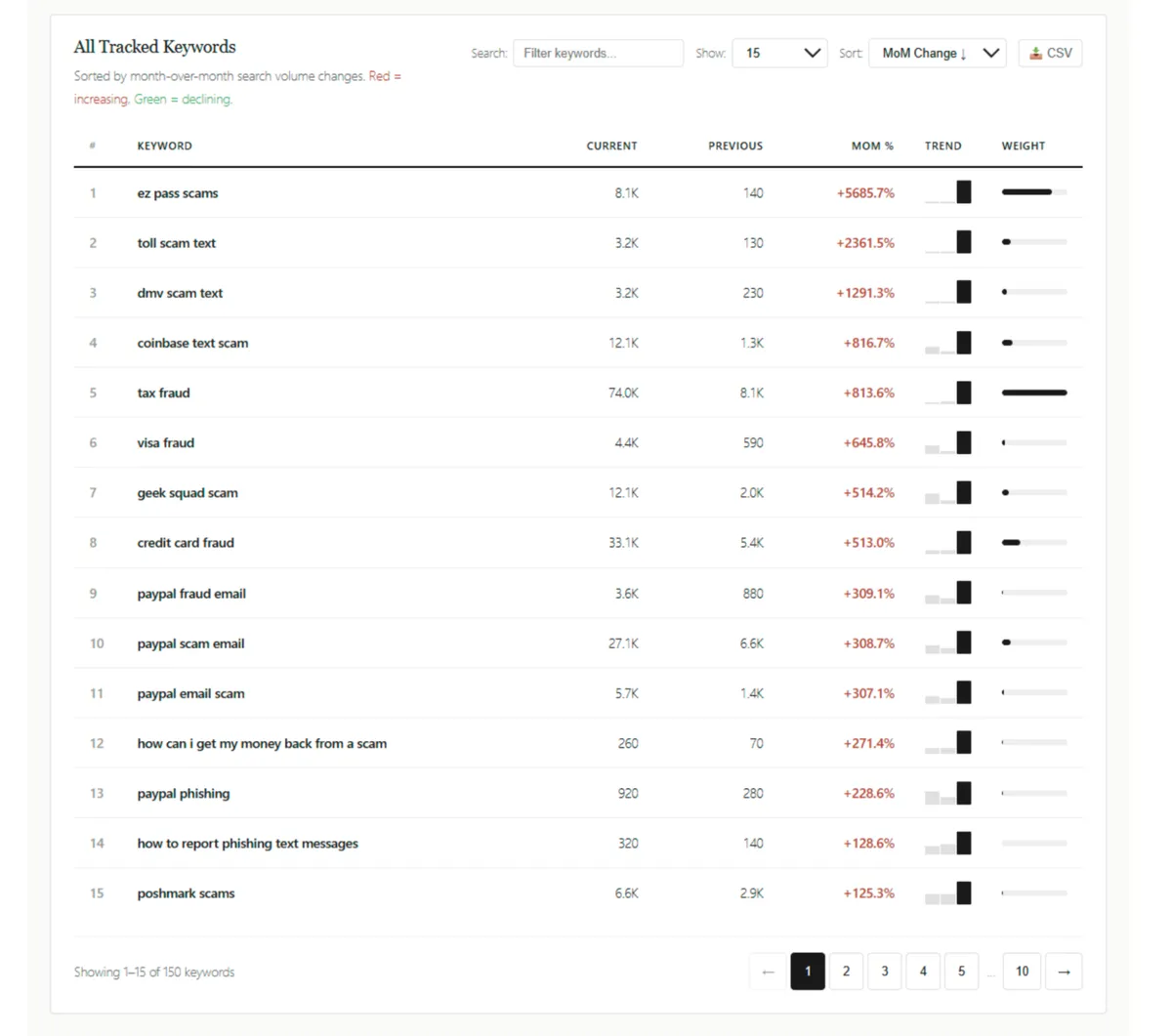
The process begins with the constant monitoring of a curated index of 150 fraud-related keywords. This list is comprehensive, spanning various categories including:
- Phishing and smishing tactics.
- Identity theft and credit card fraud.
- Cryptocurrency scams and “rug pulls.”
- Romance fraud and social engineering.
- Work-from-home and investment schemes.
2. Measure
Tracking raw volume isn’t enough; the index must account for the velocity of change. Civoryx calculates the month-over-month (MoM) change for every keyword in the index. Crucially, these changes are weighted by absolute search volume. This ensures that a 20% spike in a high-volume, mainstream term (like “bank account hack”) carries significantly more weight than a 20% spike in a niche, low-volume term. This weighting eliminates the “noise” and focuses on the signals that impact the most people.
3. Score
The final step is the aggregation of these weighted changes into the Scam Trend Score.
A rising score indicates that fraud-related search interest is accelerating globally, signaling an “active” season for scammers. A falling score indicates that interest is cooling, perhaps due to successful law enforcement crackdowns or increased public awareness of current tactics.
A Tool for Everyone: Who Uses the Index?
The Global Fraud Index was built to be a universal resource. Its applications vary depending on the needs of the user, but the value remains consistent: clarity.
Security teams use the Scam Trend Score to anticipate which types of attacks their employees or customers are likely to face in the coming weeks. If “business email compromise” keywords are spiking, it’s time to trigger an internal training module.
For those covering the tech and crime beats, Civoryx provides the data needed to back up stories with empirical evidence. Instead of saying “it feels like there are more scams,” they can point to a definitive increase in the global index.
The average user doesn’t need a degree in data science to use the index. By checking the public dashboard, they can see if a specific scam they’ve heard about is currently trending, helping them stay one step ahead of the curve.
Radical Transparency: The Pricing Model
One of the most striking aspects of Civoryx is its commitment to open access. In a world where high-level data is often hidden behind expensive corporate paywalls or “request a demo” buttons, Civoryx has taken a different path.
The data is provided as a public utility because fraud is a universal problem. By keeping the index open, Civoryx ensures that transparency doesn’t have a price tag. There are no “premium” tiers or “gated” features.
Conclusion: Staying Ahead of the Curve
As we move deeper into an era of AI-generated scams and increasingly sophisticated social engineering, the need for a “North Star” in fraud data has never been greater. Civoryx provides that direction. By focusing on what the world is searching for, the Global Fraud Index captures the reality of the threat landscape in real-time, long before it becomes a statistic in a government report.
Whether you are a professional protector of data or an individual looking to protect your savings, the Civoryx Scam Trend Score is your first line of defense in an unpredictable digital world.